Human vs. AI Copywriting: Why Human Content Still Drives 5x More Traffic
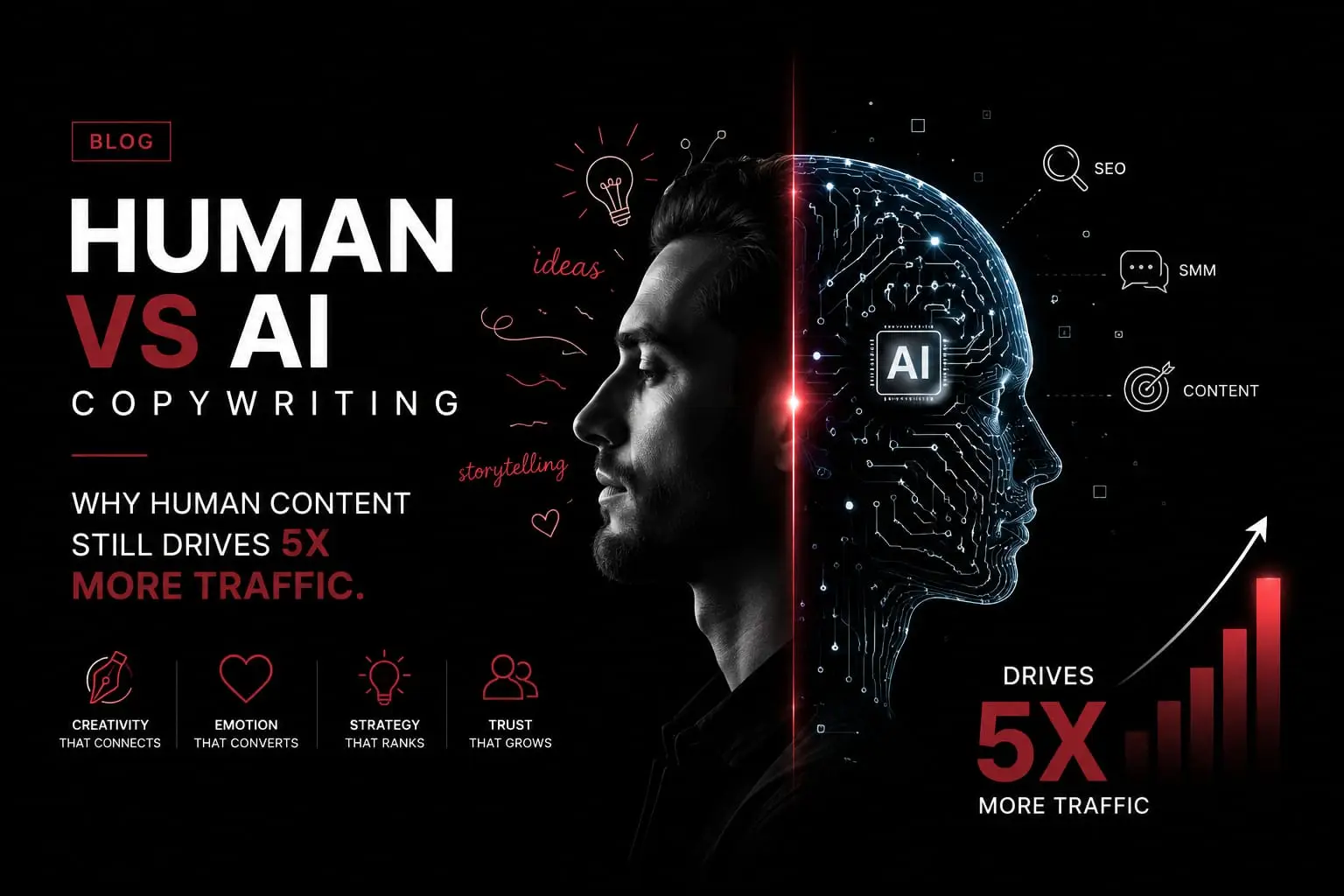
When generative AI tools exploded into the mainstream, the marketing world made a collective, breathless assumption: The copywriter is dead. Brands envisioned an endless assembly line of instantaneous, zero-cost content. For a brief moment, it worked. Websites flooded the internet with thousands of unedited, AI-generated articles. Traffic spiked, and content managers celebrated. Then came the reckoning.
Data reveals a massive, undeniable reversal. Major SEO updates completely gutted websites relying on pure, unedited AI output—with many experiencing traffic drops between 40% and 90%. Recent data from Semrush reveals an astonishing reality: Human-written content is 8 times more likely to secure the #1 spot on Google than AI-only copy, claiming the top ranking 80% of the time. When it comes to organic visibility, user retention, and final conversions, human-driven content consistently outpaces pure AI by up to 500%. Why is the “free” alternative failing so spectacularly in the race for traffic? It isn’t because Google explicitly bans AI text. It is because search engines—and more importantly, human readers—have developed an intense immunity to generic content.
1. The Death of the "Information Monopoly"
Before AI, content marketing succeeded largely by just providing answers. If a user searched “What is a financial audit checklist?” or “How do I set up a Facebook pixel?”, the brand that wrote the clearest, most comprehensive guide won the traffic.AI changed that forever. Today, anyone can generate a comprehensive, grammatically flawless, 2,000-word guide in 15 seconds. Information has become a commoditized utility.Because basic information is everywhere, its value has plummeted to zero. Users no longer need to click through ten different blogs to piece together an answer; tools like Google’s AI Overviews give them the basic summary right on the search results page.To pull a user out of the search engine and onto your website, your content cannot just aggregate existing information. It must offer something AI cannot scrape: an original point of view, proprietary data, or a unique framework. Humans create new ideas; AI merely regurgitates existing ones.
2. Google’s Evolution: The Power of E-E-A-T
Google’s algorithms are no longer focused solely on matching keywords; they are designed to evaluate E-E-A-T — Experience, Expertise, Authoritativeness, and Trustworthiness. Among these, the first “E,” Experience, is where AI-generated content often falls short. A language model can produce a well-structured article about scaling a B2B SaaS startup, but it cannot genuinely say, “When we ran this exact A/B test on our landing page last quarter, our conversion rate dropped by 14% because of this specific button placement.” That kind of insight comes from real-world involvement, experimentation, and firsthand observation.
Human copywriters bring a depth of lived experience that AI cannot replicate. They draw from actual case studies, industry expertise, client interactions, and proprietary company data to create content that feels credible and grounded in reality. Search engines increasingly reward this authenticity. Articles that include original quotes from experts, real workflow screenshots, detailed examples, and honest trial-and-error experiences are more likely to rank highly because they demonstrate genuine authority and trustworthiness. In contrast, unedited AI copy often lacks these real-world anchors, making it feel generic and less valuable to both readers and search engines, which ultimately causes it to get buried beneath more authentic content.
3. The Engagement Metric: Scroll Depth and Dwell Time
Traffic is not just about getting someone to click your link; it is about keeping them there. Search engines track user signals closely. If a user clicks your link, realizes the text reads like a dry, synthesized textbook, and hits the back button within five seconds, your rankings plummet.
AI-generated copy has a distinct signature. It is predictable, structurally uniform, and relies heavily on a recognizable vocabulary (“In today’s fast-paced digital landscape,” “Delve deeper,” “It’s crucial to remember”).
Human writers understand the invisible levers of engagement:
Content Element | Pure AI Copy | Human-Written Copy |
Hook & Intro | Formulaic, generic overviews. | Empathetic, addresses an exact pain point immediately. |
Pacing & Rhythm | Uniform sentence lengths; monotonic. | Varied sentence structures, short punchy fragments, and rhythmic flow. |
Voice & Tone | Polished but sterile; lacks brand personality. | Authentic, witty, relatable, or deliberately provocative. |
User Retention | Low dwell time; high bounce rates. | High scroll depth; drives multi-page sessions and shares. |
Human copywriters weave stories, utilize psychological triggers, change pacing, and introduce unexpected metaphors. They write for the eye and the mind, breaking up dense walls of text with scannable hooks that keep readers glued to the screen.